Last Updated: April 11, 2026
By: Amy Schlueter
If you teach struggling readers, you’ve probably had this happen too many times to count.
A student confidently reads hop…
Then stops dead in his tracks when he sees hope…or worse, he says, “hop..eeee???”
Then you tell them what it says and the look on their face clearly says: Hunh???? How does it say that?
Welcome to the life changing world of the v_e syllable (known in my class as Super Hero E- see previous post “When Super Hero E flies in…”). Once students understand that the vowel says its name and the e is quietly helping out that vowel, decoding suddenly becomes much easier.
The tricky part? Students need a lot of practice with this pattern.
And if that practice looks like boredom, motivation disappears faster than the class pencil supply in September.
The good news is that structured literacy doesn’t have to feel repetitive. With the right activities, students get the explicit phonics practice they need while actually enjoying the lesson. So make it fun. Make it lighthearted. Add lots of variety and soon your students will be excited to read those tricky words!
Here are a handful of FUN yet effective ideas that work beautifully in small groups, reading intervention, and structured literacy classrooms. And if you’re teaching a Wilson lesson these are great activities to roll your day!
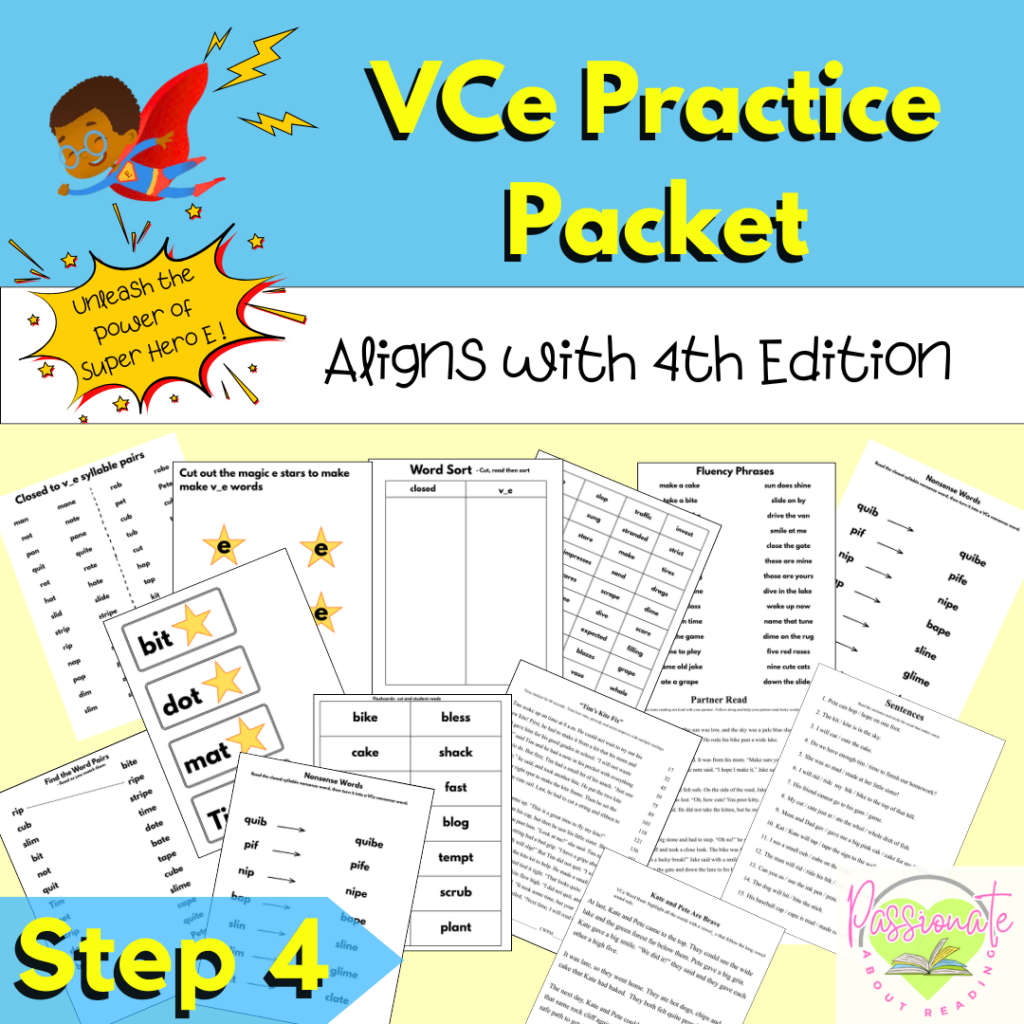
1. v_e comparison page
Start with a long list of words in two columns. The left column contains a single, closed-syllable word. The right column has its partner with an e added onto the end. Read left to right, demonstrating for your students that cap becomes cape, mop becomes mope, not becomes note. Then have your students take turns reading one line at a time. I point out that not only does the v_e word sound completely different but it also has a completely different meaning. This is a great way to build and reinforce vocabulary, too. For my kiddos on the super struggle bus, I have them tell me the meaning of each word they read or use it in a sentence. This is a powerful way to teach how the silent e works.
That moment when they realize one tiny letter changed the entire vowel sound and meaning of the word is pure teacher gold. And that’s why I love SuperHero E so much. This may be the day when half your group says, “Ohhhh… I get it now-.” If not- keep reading!
2. Add e to an existing word
Start with a huge font. Print single, closed-syllable words on it and put a big star graphic at the end of the word. Print and cut out a big star with an e printed on it.
Students read the closed syllable word, then add the e to make a v_e word. This builds on the first activity because they are actively changing the word (multi-sensory activity) from a closed syllable to a v_e syllable word.
3. VCe Word Sorting
Word sorting helps students visually compare closed syllables and silent e syllables.
Give students mixed word cards with single syllable words (unless it has vowel containing suffix) like cap, cape, fire, crunches, fell, blame
Students sort them into two piles:
Short vowel words
Silent e words
Once sorted, have them read both columns aloud. Some students will dramatically announce, “Hey- this is getting easier!”
Honestly… they’re not wrong.
4. Phonics Card Games
If you want instant engagement during reading intervention, turn phonics practice into a game.
Create a deck of VCe word cards. Students take turns drawing a card and reading the word. If they read it correctly, they keep it.
Add a few surprise cards like:
- Lose a turn
- Trade cards
- Steal a card
Suddenly students are extremely invested in correctly reading words like cube, bike, and hope.
Amazing what a little friendly competition can do. Check out my UNO and Kaboom! Cards for Step 4 to practice the VCe targeted skill.
5. Fluency Passages for Silent E Words
Once students can decode VCe words, they need practice reading them in connected authentic (not just decodable) text. I like to create texts with a low Lexile so that they’re not overwhelmed but still skill-building.
Short fluency passages filled with silent e words help students:
- build automaticity
- improve accuracy
- strengthen reading confidence
Students can reread the passage multiple times to improve their speed and smoothness.
And yes, you will hear things like:
“Wait… I beat my time!”
Which is always a beautiful sound in a reading room.
6. Color by Code Phonics Practice
Color by Code activities are one of the easiest ways to sneak in phonics review.
Students read a word, identify the phonics pattern, and color the matching section.
Students stay engaged because they’re focused on revealing the picture, not realizing how much decoding practice they’re actually doing. It’s basically a teacher superpower. And I have a ton of these in my store!
7. VCe Fluency Phrase Practice
Before moving into full sentences, short phrases help students practice smooth, automatic reading.
Examples include:
the brave snake
a huge cube
rode a bike
ate a grape
made a cake
These quick phrases give students repetition without overwhelming them.
Plus, phrases like the brave snake tend to spark interesting classroom debates about why the snake is brave in the first place.
8. Partner Reading
Partner reading works beautifully in small groups.
Give students a short VCe passage and let them take turns reading sentences.
While one student reads, the partner follows along and helps with tricky words.
Students often feel less pressure reading with a peer, and they get extra repetition with the target pattern.
Also, it’s amazing how quickly students become very serious reading coaches for each other.
9. VCe Word Hunts
Students love a challenge.
After introducing the VCe pattern, give students a short passage and ask them to hunt for silent e words.
They can:
- highlight them
- circle them
- list them on a whiteboard
Suddenly students are spotting words like hope, late, and made everywhere.
Once they start noticing spelling patterns in real text, decoding becomes much easier.
10. Word Choice Challenge
Give students a set of simple, engaging sentences—each one with at least two word choices. Their job? Read closely, think it through, and pick the word that actually makes sense (no guessing allowed 😉).
Each pair of words targets a specific phonics pattern—like closed vs. VCe—so students aren’t just choosing randomly. They’re connecting spelling to meaning and seeing how one small change (hello, Super Hero E!) can completely shift a sentence.
This kind of practice does more than build decoding skills. It strengthens comprehension, sharpens attention to detail, and nudges students to slow down and really process what they’re reading.
The result? More accurate reading, stronger word recognition, and a nice little boost in confidence every time they get it right.
11. Flashcards
End your lesson with a quick one-minute challenge. Show word cards and see how many VCe words students can read in sixty seconds. OR call out the word and have students SPELL it correctly.
Students love trying to beat their previous score. And when someone proudly announces, “I got twelve this time!” the entire group usually wants another round.
Which, conveniently, means more decoding practice.
Why the VCe Pattern Matters
The letter e is basically the Super Hero of the English language—quiet, but powerful. This one little letter at the end of a word completely transforms it, like a linguistic glow-up: Think of it as a built-in phonics rule that boosts decoding efficiency. Fewer guesses, more accurate reads. Boom—brain energy saved.
From a cognitive standpoint, mastering VCe helps strengthen orthographic mapping (fancy term, big payoff). Students start storing these patterns in long-term memory, which means faster word recognition and less mental strain while reading. In other words, their brains go from “Wait…what is this word?” to “Oh yeah, I know you, my friend.”
And here’s where it gets really good: once students crack the VCe code, they suddenly have access to hundreds of high-frequency words. It’s like unlocking a new level in a video game—but instead of coins, they earn fluency.
For struggling readers, this isn’t just about decoding—it’s about momentum. Each correct word read reinforces neural pathways and self-belief. And let’s be honest, confidence is kind of the secret ingredient in all learning.
So yes, that “silent e” may not make a sound…
but it definitely makes a statement.
Final Thoughts
Teaching the VCe syllable pattern doesn’t have to feel repetitive.
With the right mix of structured literacy instruction, engaging activities, and a little humor, students get the repetition they need without losing motivation.
Because when students are laughing about a snake wearing a cape on a skate, something important is happening.
They’re practicing real decoding skills.
And they’re starting to believe something many struggling readers don’t believe yet:
Maybe reading isn’t so bad after all. 📚
No time to incorporate all these great ideas into your lessons? Get my Zero Prep VCe Activity Packet here to save your coffee break and sanity.