Last Updated: April 25, 2026
By: Amy Schlueter
You know the moment.
Your student skywrites with full Broadway energy, chants the word like it’s their job… and then looks at you two minutes later like, “Never seen that word in my life.”
Cue the internal scream.
Here’s the truth: memorization alone is not enough—especially for struggling readers or those with weaker working memory. If a word isn’t anchored to something meaningful, it disappears faster than your lunch break.
A Real Student
Let me tell you about Jared*
I’ve had him since 5th grade (he’s now nearing the end of 6th), and when I first met him… he couldn’t read words like said, would, could, where, were, again.
This is a student with an IEP since 1st grade. Years of intervention. Solid effort from teachers.
So what was going wrong?
Honestly… the approach just wasn’t sticking.
Jared didn’t need more of the same—he needed a different level of support.
Think of it like this: if someone comes into a trauma unit, you don’t hand them a bandaid and hope for the best. You don’t say, “Let’s just try that exactly the same again, but harder.”
Instead, you assess what’s actually going wrong.
You stabilize.
You intervene with intention.
That’s what Jared needed.
For years, he’d been exposed to these words—again and again—but nothing was sticking. It wasn’t a practice problem. It was a precision problem.
Once the instruction became targeted, structured, and multisensory—like the educational version of a trauma response—things started to shift.
Not instantly. Not perfectly.
But meaningfully.
Because when the approach matches the need, that’s when progress finally has a chance.
Jared is still behind—and he may always be—but here’s the difference:
Now, when he sees a sight word, he can usually get it within a couple of seconds.
That hesitation? That panic? It’s so much less.
That’s real progress.
So what made the difference?
It wasn’t more practice—it was a smarter approach.
*not his real name
So What Actually Works?
A short, intentional mini lesson.
We’re talking 5–10 minutes. That’s it. Not a full production. Not a 20-minute deep dive. Just a focused routine that helps students connect to the word in multiple ways.
What’s the difference?
They need to hear it, say it, build it, manipulate it, and interact with it using more than just a pencil and a prayer.
That’s where multisensory strategies come in—and no, they don’t have to be complicated or Pinterest-perfect. Simple things like pattern recognition, tapping, marking, mapping, and building common words give students something concrete to hold onto.
When a student can feel and see what’s happening in a word, it stops being random. It becomes learnable.
Multisensory doesn’t mean complicated. Think:
- Gel bags
- Sound tapping & mapping
- Marking words
- Word building (tiles or whiteboards)
- Pattern spotting
- Using in a short sentence and circling the word.
When words become concrete, they become learnable.
Less Words = More Wins
Let’s stop the 15-word overwhelm, shall we?
- Start with as few as 3 words a week if needed
- Nothing kills enthusiasm faster than overkill- go at the pace they need
- Teach deeply, not widely
- Revisit often (spiral, don’t dump)
And please—teach by pattern → it’s more efficient for YOU and for THEM
- could, would, should = one pattern, not three random nightmares
- Taste, waste, paste
- Way, away
- Again, against
Getting Started (Keep It Simple)
- Commit to mini lessons at least 3 days a week
- Keep it short: 5–11 minutes
- Use multisensory strategies (rotate 5–6 from a bank of options to keep it fresh)
- Use Frye or Dolch word lists, words from your intervention program or missed in real text
- Send home flashcards for a 5-minute practice routine
- Start slow—go as fast as you can, but as slow as they need
Pro Tips That Make Life Easier
- Establish a consistent routine (predictability = success)
- Let students gather materials once they know the flow (hello, faster transitions 🙌)
- Great as a warm-up or it fits beautifully into Part 3 of Wilson lessons
- Perfect for struggling readers, students with poor working memory, or English language learners
Final Thoughts
When you shift from random practice to structured, meaningful repetition, everything changes.
- Less guessing
- Less freezing
- More confidence
- Greater automaticity
- More “Hey, I actually know this!” moments
One of the most beautiful results I see is my students confidently conquering words they “should” (gothcha!) know. And honestly… that’s the goal.
If you’ve been stuck in the cycle of drill, repeat, forget… it might not be your students. It might just be the routine.
A small tweak can make a big difference.
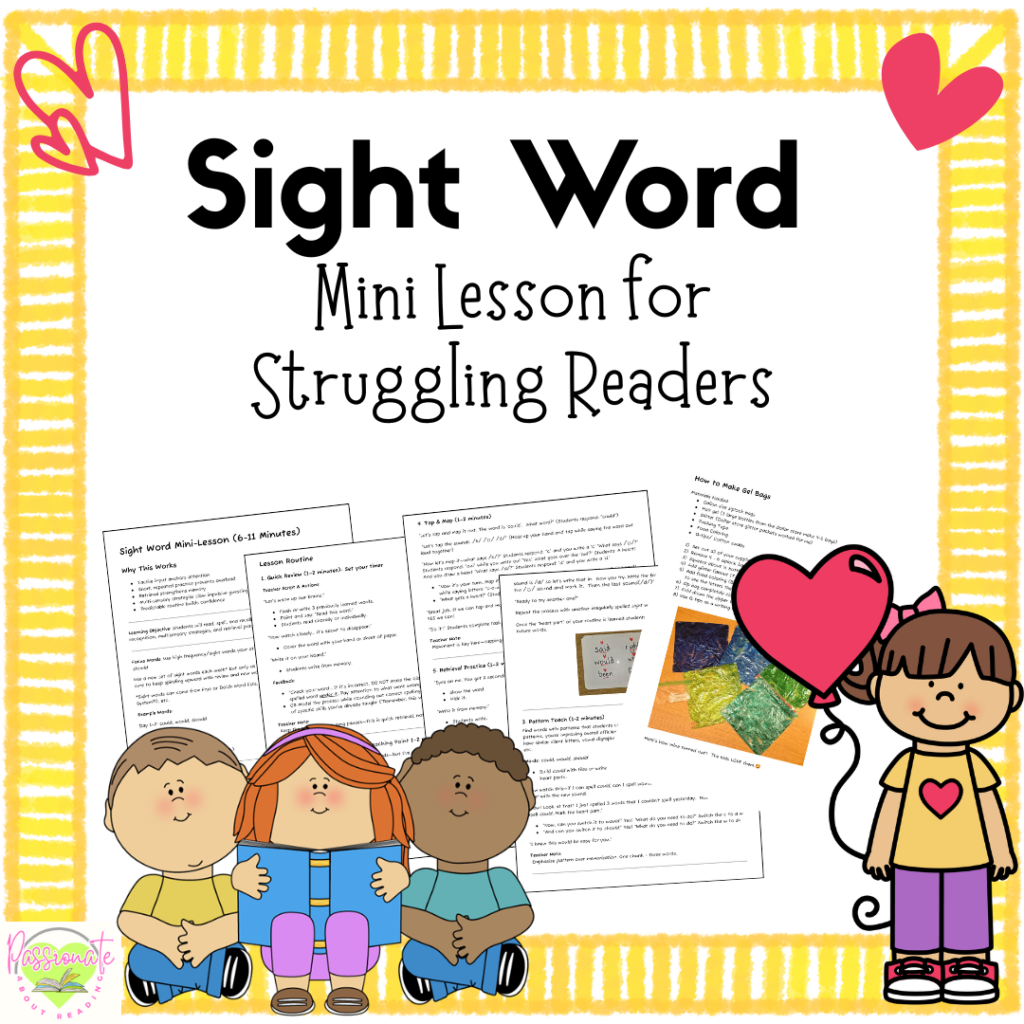
And if you’re looking for a simple, structured way to put all of this into practice—without having to reinvent the wheel—I’ve put together my go-to sight word mini lesson routine that walks you through it step-by-step.
Because let’s be real… we’ve all got enough on our plates already.