Last Updated: January 24, 2026
By: Amy Schlueter
Your Hunch Was Right! Students Aren’t “Just Memorizing”
If you work with dyslexic or struggling readers, you’ve probably seen it: the same passage, read again and again, suddenly sounds smoother. Faster. More confident. Cue the data—ORF jumps 30%, 50%, sometimes even 100%. At some point you think, Surely this can’t just be magic… or memorization… or witchcraft.
Good news: it’s neuroscience. No cauldron required.
Hebb’s Law: The Brain’s Favorite Rule
Hebb’s Law is often summed up as “neurons that fire together wire together.” Basically, the brain is a muscle mama. The pathways you use repeatedly? They get stronger. The ones you don’t? They… skip leg day.
Reading fluency isn’t one skill—it’s a whole team effort:
- decoding
- speech production
- meaning
- phrasing and expression
When a student rereads the same passage accurately, all of those systems fire together again and again. The brain goes, “Oh, THIS again? Cool. I’ll make this easier next time.” And it does.
Why Dyslexic Readers Benefit So Much
New text is like throwing a dyslexic reader onto an obstacle course while timing them. Repeated reading removes the surprise factor. By the second or third read, decoding isn’t hogging all the brain power anymore, which means there’s room for fluency and prosody to show up.
That’s why gains often look dramatic. Once the pathway clicks, fluency doesn’t crawl—it leaps.
Fluency ≠ Speed (Despite What Timers Suggest)
Fluency is about coordination, not racing. Hebb’s Law doesn’t reward speed; it rewards accurate, synchronized repetition. That’s why students suddenly start sounding like readers instead of robots reading IKEA instructions. And we all know that fluency isn’t just speed. It’s the bridge between decoding and comprehension. As fluency improves, students free up cognitive energy for meaning — which is why we do a little mental, or in my case, literal happy dance when fluency finally clicks.
Research Supports Repeated Reading
There’s a strong body of evidence showing that repeated reading improves reading fluency for students with reading difficulties, including those with dyslexia. A meta-analysis of 34 studies found that repeated reading interventions produce significant gains in reading fluency (correct words per minute) for students with reading disabilities, especially in the elementary grades.
Other research shows repeated reading — especially when combined with modeling (listening to fluent reading first) and feedback — improves prosody (expression) and fluency more than just speed-focused practice.
Repeated reading also predicts longer-term reading development beyond immediate gains, especially when meaning and comprehension are emphasized alongside fluency. I’ve seen this at work in my own classroom to my AND MY STUDENTS’ utter delight! Over time, these repeated readings have translated to improved fluency and prosody not just with repeated readings but with cold reads of new text. For example, one of my super strugglers started the year reading 49 wpm for a cold read and now she’s consistently reading 70 wpm for cold reads. I’ve watched my students’ numbers go up and up and up.
A Quick Warning (Because Science Is Honest)
Hebb’s Law wires whatever is repeated—even mistakes. If students repeatedly guess or read inaccurately, the brain happily strengthens those pathways too. Zero judgment. Brains are loyal, not picky.
This is why your success likely comes from:
- controlled text
- modeling
- immediate correction
- purposeful rereads
It is NOT “read it ten times and hope for the best.”
What Works Best in Practice
The research highlights a few common threads:
- Model the fluent reading first (teacher or audio).
- Give immediate corrective feedback so mistakes don’t get bottled up into “well-repeated habits.”
- Reread meaningful, manageable passages to build automaticity and expression.
This focus on accurate repetition explains why your learners can go from slow and cautious to confident and expressive — sometimes in what feels like record time.
How to Get Started with Repeated Readings (Without Losing Your Mind)
One of the best things about repeated readings is that they’re shockingly low-effort for how powerful they are. No shiny new curriculum. No color printer marathon. No 45-minute block that magically appears in your day. Just consistency.
Start by getting student buy-in, and do it fast. I use a one-minute tooth-brushing talk that never fails. Ask your students: “Do you brush your teeth?” (Yes.) “Every day?” (Yes.) “Some of you even twice a day?” (Whoa, overachievers.) Then ask how long it takes. When they say a minute or two, that’s your opening. Fluency practice is like brushing your teeth. It only takes a minute, but it keeps your reading healthy for life. Then ask the dramatic question: “What happens if you stop brushing your teeth?” When they shout “They rot!” you can calmly respond, “Exactly. Same thing with reading. If we don’t read… our skills rot.” Suddenly, everyone’s on board because no one argues with dental science.
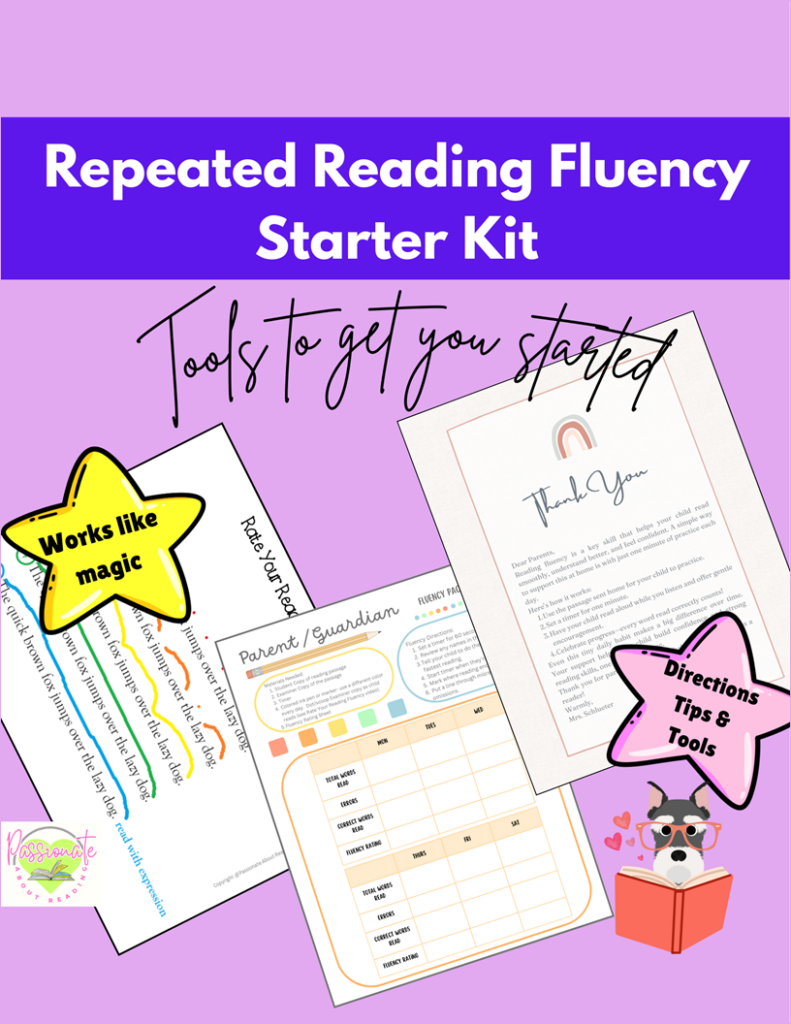
Next, bring parents into the loop. Create a simple fluency letter explaining what repeated readings are, why they matter, and that this is a one-minute practice—not a nightly reading marathon. Invite parents to reinforce what you’re already doing in class so kids get a consistent message (and so no one invents their own system).
For texts, keep it intentional. I’ve been using this set of decodable passages when students are practicing specific phonics patterns and I send home grade-level passages for broader fluency practice.
Send home fluency folders with two passages to use over two weeks. Include a fluency scoring sheet for home use, a simple fluency rating scale, and short videos showing parents exactly how to score. (Because if you don’t show them, someone will absolutely count words creatively.)
And if you want to make your own numbered fluency passages here’s a great resource from Intervention Central. Keep it simple, keep it routine, and remember: fluency isn’t fancy—it’s functional. Just like brushing your teeth. 🪥📚
The Takeaway
Repeated reading works because it aligns with how the brain learns. Your students aren’t memorizing—they’re building neural efficiency. Those ORF gains aren’t flukes. They’re biology doing its thing.
And honestly? When neuroscience agrees with what teachers figured out years ago, that’s just very satisfying. 😌
No time to do everything I mentioned above but you’re ready to start seeing those fluency scores go up? Check out my Repeated Readings Starter Kit here.