Why Waiting for a Struggling Reader to Catch Up Is a Gamble We Shouldn’t Take
Last Updated: 10/17/26
By: Amy Schlueter
Let’s talk about something I will defend until my last breath: the right of every struggling reader to receive the instruction and support they need to become a capable, confident reader.
If wishful thinking taught kids to read, I’d be sipping a cool drink on my patio instead of slogging through another school year, arguing for kids’ rights to sufficient instructional minutes.
I’ve spent years working with students who struggle to read. I’ve watched children fight through words that other students barely notice. I’ve watched them guess, skip, stumble, and quietly decide that reading just isn’t their thing. I’ve also watched the magic happen when instruction begins to click and a child realizes, sometimes for the very first time, Hey, I can actually do this.
Those moments are why I do this work. But there’s a phrase that makes my reading-specialist stomach clench: “Let’s wait and see.” Let’s wait and see if he catches up. Let’s wait and see if she becomes more motivated. Let’s wait and see if another year of classroom instruction does the trick. Let’s wait and see if we can squeeze reading intervention around everything else on the schedule.
And my personal favorite? “Some kids just develop later.” Well, yes. Children develop at different rates. But a child who is struggling to read doesn’t need us to predict the future. That child needs us to look at the evidence in front of us and decide what to do next. Because while we’re waiting to see what happens, the child is still growing up. And the reading demands aren’t waiting.
My Father-in-Law: A Story of Possibility
My father-in-law dropped out of high school for a lot of reasons that snowballed- one of which was his frustration in having his needs unmet due to dyslexia. But that’s a story for another time. The result was he left home at 15 and spent time working in factories in and around Chicago. Eventually, his older brother took him in and helped him get an apprenticeship in printing. My father-in-law had an exceptional work ethic and was very smart. He learned his trade, became known for the quality of his work, and built a successful life. I admire his story tremendously. He overcame a difficult beginning, found an opportunity, and made something of it.
His life reminds me that a rough start doesn’t have to determine a person’s destination. People can surprise us. They can develop skills, discover strengths, and accomplish things nobody might have predicted when they were young. But here’s where I think we sometimes get the lesson wrong: One person’s success story should never become our excuse for withholding help from someone else.
My father-in-law’s story doesn’t prove that struggling students will be fine without intervention. It proves that human potential is not always obvious at the beginning. And those are two very different things. We can’t look at a child who is struggling in fourth grade and confidently predict that he will become a successful adult. We also can’t look at that same child and decide that his struggles today tell us everything we need to know about his future.
What we should do is provide opportunities, teach necessary skills, identify barriers, and refuse to let a child’s current performance become a permanent label. Hope is essential. But hope without action is just wishful thinking wearing a cute little teacher cardigan.
When the Road Takes a Different Turn
And then there’s Cody.* He’s the son of an acquaintance. Cody struggled in school, began using drugs, and eventually ended up in jail after being caught stealing and breaking into places to support his habit. It’s gut wrenching to think about. I don’t know every factor that contributed to his choices, and I would never claim that reading difficulties caused his drug use or incarceration. Human lives are far too complicated for that kind of simplistic explanation. But his story reminds me of something important: children grow into adults, and the challenges they face can become much harder to navigate as they get older.
Let’s be clear- school struggles don’t automatically lead to trouble with the law. Many people who struggle academically build wonderful lives, and many people who experience addiction or incarceration have complex histories that cannot be reduced to a single childhood difficulty. Still, we should care deeply about whether our students leave school with the skills they need to participate in the world around them. Can they read a job application? Understand a rental agreement? Follow written instructions at work? Read a prescription label or medical discharge instructions? Can they make sense of a paycheck or a document that requires a decision? These aren’t bonus skills reserved for the students who happen to enjoy reading. They’re part of everyday independence.
The National Center for Education Statistics’ report, Literacy Behind Bars, is a wonderfully detailed examination of the literacy skills of incarcerated adults and explores relationships among literacy, education, employment training, and criminal history. The Executive Summary (pages 5-9) gives a great overview.
This study does not establish that poor reading causes incarceration, but it does shine a light on the fact that literacy rates are lower for incarcerated individuals than those living in households. And, for my nerd brain, it shows why literacy deserves a place in conversations about education, opportunity, and life after school.
I don’t want any of my students to become a statistic of lost opportunities. I want them to have choices. I want them to be able to advocate for themselves, pursue their interests, find meaningful work, and navigate adulthood with confidence. I know we can’t guarantee any of those outcomes.
But why wouldn’t we do everything reasonably possible to equip them for success?
Arjun*: When a Schedule Doesn’t Match a Student’s Needs
Let me bring this argument into my own school. Arjun*, a sixth grader, emigrated to the U.S. and ended up in our district sometime in 4th grade. He has significant reading difficulties. I’m still trying to figure out if it’s language, a reading disability, or a little of both. He doesn’t have the ability to work independently with text, access homework, and manage reading demands woven throughout his school day. He couldn’t even complete a word search from his science teacher containing lab safety vocabulary.
He needs intensive support. Yet my principal wants to divide his barely doable reading support minutes- only 30 a day- with math support because he believes no school subject should be eliminated.
Now, let me be clear: I am not suggesting that social studies and electives don’t matter. Of course they do. However, instead of focusing on whether every subject appears on students’ schedules shouldn’t we be focusing on whether that student can access the learning we’re providing?
Arjun needs to read directions, understand the word problems, access a textbook, complete assignments, and gradually become more independent. When a student can’t independently access resources used throughout the school day, reading support is no longer just one more thing competing for a spot on the timetable. It’s a necessity that affects his access to every other subject.
Consider the vocabulary encountered in 6th grade social studies: conqueror, gladiator, aqueduct, monarchy, crusade, plague, renaissance.
A content-area teacher can introduce these words with great visuals, oral explanations, and build background knowledge. Those are all key supports, but teachers can’t easily modify every complex, multisyllabic word with a simpler version. And administrators shouldn’t expect them to modify their entire curriculum for a struggling reader. Their expertise and support can’t replace the explicit instruction a student needs to address significant reading deficits. Just because an expert teacher can explain aqueduct beautifully, doesn’t mean their struggling readers will independently decode and comprehend a page about the Roman Empire tomorrow.
Instructional minutes are precious- we all know how fleeting time is. We all feel that days are long, but weeks are short. As I write this, 1st quarter ended today. Already?! UGH! So this is where I get nervous about the phrase “no subject should be eliminated.”
Fairness doesn’t look the same for every student. Fairness means focusing on what’s needed most and providing it- especially when we have the resources to carry it out. If a student requires intensive reading instruction, reducing that instruction simply to make the schedule look balanced and “fair” has consequences beyond the reading block.
A perfectly balanced schedule can leave a student unable to access the curriculum.
I know scheduling is complicated. Schools have limited minutes, competing priorities, staffing constraints, and students who need help in multiple areas. There isn’t always an easy answer. But that’s why we need to make decisions based on student data, instructional priorities, and a clear understanding of what the student can and cannot do independently.
More importantly, we should have the wisdom to know that less intervention time is harmful even though the schedule looks equitable.
Allan*: The Moment That Reminds Me Why I Keep Fighting
And then there’s Allan- a sixth grader- and one of my most significant reading strugglers. Progress is slow. Reading is hard work. He still has trouble holding high frequency words in his head, despite seeing them everyday. Skills that other students can pick up fairly quickly require daily review, careful instruction, a very slow pace and a great deal of patience. There are still days when I wonder if it’s going to click, but lately, I see more glimmers of hope.
Allan tells me he likes reading now. He likes going to the library. Yup. You read that right- he’s picking books out (with the help of our amazing librarian) and reading them. He SEES his own improvement. For the first time yesterday he said, “Look how much better I did than yesterday. I had more mistakes, but I did better in all the other areas.” I cannot adequately explain how much that means to me. This is a boy who always looked for confirmation that he can’t do it.
It’s still too early to say that he’s completely changed his mindset, but he’s experiencing something more powerful than a better score on a fluency passage. He’s discovering that reading can be enjoyable, that his efforts pay off, and that he’s capable of doing something that once felt impossible. He’s gone from reading 17 words a minute to 50. He’s gone from not being able to read Frye’s first 100 words to reading a 3rd grade list of sight words.
As a result he’s starting to see himself differently. Instead of viewing reading as impossible, he’s beginning to see it as something he can do—and something he might actually enjoy. That’s enormous! And it’s why I get so frustrated when intervention is treated as an expendable extra that can be trimmed whenever the schedule gets crowded.
We talk about standardized testing, school report cards, and college readiness in our buildings and across our districts and ask, “How can we move more students into the ‘Exceeds’ category?” But what about focusing on our lowest groups- our underachievers, our English language learners, our lowest income students? Because behind every data point is a child. A child who might eventually choose a book at the library because he wants to read it. A child who might raise her hand instead of hoping the teacher doesn’t call on her. A child who might tackle an assignment independently rather than waiting for someone to rescue him. A small human who might begin to believe that she is capable of learning difficult things.
That’s what I’m seeing in Allan. And it fills me with joy. Will all of my students feel like him? No. Will every student need the same amount of intervention? Absolutely not. Some students need intensive support for years. Others make faster progress. Some require us to rethink our approach, intensify instruction, or address additional barriers.
That’s why we assess, teach, monitor, and adjust. We don’t assume that one child’s success guarantees another’s. And we can’t stamp a one-size-fits-all approach to their school day because we think it’s “fair.”
We need to use what we know about effective instruction, examine what research tells us, and keep adjusting for that student sitting right in front of us.
Amy’s Take: Let’s Stop Waiting for a Different Ending
My father-in-law reminds me that a difficult beginning does not determine a person’s future.
Cody who ended up in jail reminds me that life can take painful turns, and that we should care deeply about the opportunities and skills children carry into adulthood.
Arjun reminds me that the decisions we make about instructional time affect real humans—way more than what looks good on paper.
And Allan reminds me why I keep showing up. He likes reading now. He likes going to the library. He sees his own improvement.
That’s the kind of progress that makes all the hard work worthwhile.
We can’t promise that every struggling reader will become a fluent reader, graduate from high school, attend college, or find a fulfilling career. Life is complex and no one can promise those things.
But what I firmly stand on is that we give students meaningful opportunities to learn, and that we take reading difficulties seriously. I will keep fighting for intervention decisions guided by student needs rather than assumptions about what children will eventually outgrow.
We don’t have to know how a child’s story will end to take responsibility for what happens next.
Let’s stop treating reading intervention as an expendable luxury. Let’s stop using one person’s extraordinary success as proof that every struggling student will be fine without adequate support. Because sometimes, the difference between a child who gives up and a child who begins to believe in himself is a skilled teacher, sufficient instructional time, and someone who refuses to give up.
And if we have the opportunity to be that someone, why on earth wouldn’t we?
🤓 Research Nerd Corner: Older Students Still Need Reading Instruction
One of the biggest misconceptions about reading is that foundational skills are only relevant in the primary grades. Research tells a more complicated story.
The What Works Clearinghouse’s Providing Reading Interventions for Students in Grades 4–9 identifies building decoding skills for complex multisyllabic words as a recommendation supported by strong evidence. Older students who struggle to decode still need instruction that addresses those skills—not simply more opportunities to encounter difficult text.
A 2026 meta-analysis by Yi and colleagues, published in Educational Psychology Review, examined 34 studies involving 2,718 middle- and high-school students. The researchers found statistically significant positive effects of targeted word-reading interventions on decoding, nonword decoding, reading comprehension, and spelling. They also emphasized that more research is needed to determine which approaches work best.
Here’s what matters to me as a reading specialist: being older doesn’t mean a student no longer needs foundational reading instruction.
We need to assess the student in front of us, identify the skills that are missing, provide appropriate instruction, and monitor progress. We shouldn’t assume that students will outgrow reading difficulties simply because they’ve reached middle school. And we shouldn’t confuse a student’s age with evidence that the instruction is no longer necessary.
Sources: What Works Clearinghouse, Grades 4–9 Practice Guide; Yi et al. (2026), full open-access article.
Here are some other great articles that you might want to peruse to support your cause:
- National Reading Panel: Research Findings on Effective Reading Instruction — Evidence on phonics, fluency, and other essential components of reading instruction.
- Providing Reading Interventions for Students in Grades 4–9 A free practical how-to guide
- Literacy Behind Bars: National Center for Education Statistics — A free government report examining literacy among incarcerated adults and its relationship to education and other life experiences.
- Literacy in Everyday Life: National Assessment of Adult Literacy — Research on adult literacy skills used in everyday contexts.
*- Names have been changed to protect privacy.
I’d love to hear your thoughts! What’s going on in your school that’s working? What needs to change? Thanks for spending time hanging out in my blog, and until next time, don’t ever stop changing the world- one reader at a time.
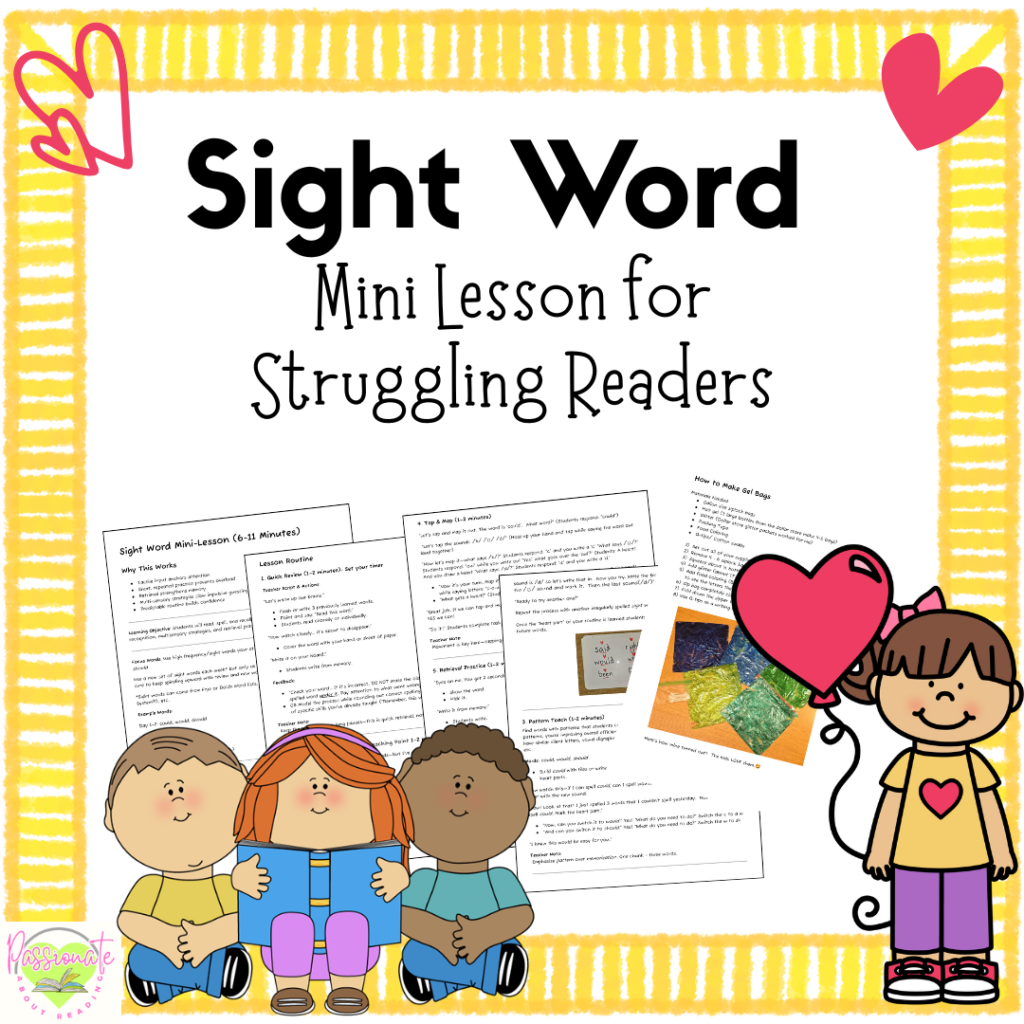
One more thing before you go- here’s what I’ve been using to help Allan with sight words- and it works! 😍