Last Updated: 10/2/26
By: Amy Schlueter
Just because a student can read the words doesn’t mean they’ve learned to read them automatically.
I love decoding instruction. There. I said it. Give me a phonics lesson, a word list, some tapping, a few nonsense words, and a kid who is finally figuring out that the letters on the page actually mean something—and I’m a happy reading specialist.
And yes, I will absolutely argue that accuracy comes first. But here’s the taboo: A student who can decode accurately, does not equal fluent reading. Nope. Not even close. Wouldn’t that be nice, though? Teach the phonics pattern. Check the decoding box. Send the kid on their merry reading way. Unfortunately, some of our readers don’t get that memo. They become accurate…and painfully slow.
And that’s where things get interesting.
Accuracy First: Of Course it Matters
Before we talk about fluency, let’s talk about something I will argue for until the sun burns out: Students need explicit, systematic instruction in how words work.
For struggling readers, we can’t simply cross our fingers, hand them a book, and hope enough exposure magically sorts everything out. And this isn’t just for all you reading specialists/interventionists. Sending a big shout out to the classroom teachers who take a moment to help their students understand the why behind the word. The National Reading Panel’s review found that systematic phonics instruction produces significant benefits in reading and spelling, including children who have difficulty learning to read.
And the What Works Clearinghouse’s guidance for students in grades 4–9 (you did not read that wrong- grades FOUR TO NINE) gives strong evidence for building students’ decoding skills so they can read increasingly complex words. This is why direct instruction matters. And this is why what you do in the classroom matters…phonics shouldn’t stop at 3rd grade. As text complexity increases, so will the appearance of the words your students are reading. I want my students to know what to do when they encounter a word they don’t know. And when they make an error? I don’t just give them the word. I make them go back and try again. If a student reads gaping as gapping, I don’t rescue them for time’s sake. I say “Try again” at least once before I help with clues. “How many p’s are there? What’s the spelling rule? What makes sense here? Don’t guess.”
Because the student doing the thinking is the student doing the learning. If I continually supply the correct word, I may get us through the sentence today—but I’m robbing them of the chance to figure it out tomorrow. And what’s the point of teaching a skill if I don’t make them utilize it? So, yeah, accuracy matters.
But accuracy is not the finish line. Not even close.
Enter the Slow-but-Accurate Reader
Here’s the part that doesn’t always get enough attention. A student can get much, much better at decoding…
…and still read like they’re trudging through 2 and a half feet of snow. Every. Single. Word. They may know their phonics patterns. And how to decode multisyllabic words. They may even be 98% accurate. But they’re still putting spaces between words instead of reading a sentence smoothly. And this makes sense when you look at the research on automaticity. LaBerge and Samuels’ classic model of reading describes a progression from processing that requires conscious attention toward increasingly automatic processing. When word recognition requires less conscious effort, more cognitive resources are available for meaning-making. In other words: Knowing how to decode a word and being able to recognize it effortlessly are not the same thing.
And that difference matters.
Fluency Doesn’t Just “Happen”
This is where we can drop the ball with our struggling readers. We spend years working hard to help them become accurate decoders—and rightly so. Then they finally become very accurate……and then we either keep them in a phonics intervention that they no longer need or we expect fluency to magically appear. But fluency is its own area of instruction.
The National Reading Panel found that repeated oral reading—with guidance and feedback—had a positive impact on word recognition, fluency, and comprehension. Their review specifically concluded that word-recognition accuracy is not the endpoint of reading instruction. And the current What Works Clearinghouse guidance for grades 4–9 makes the same basic point from a practical intervention standpoint: provide purposeful fluency-building activities to help students read effortlessly. That’s a pretty important distinction. We can’t simply leave our students at proficient decoding. We have to take the next step to help them move toward reading that is automatic, appropriately paced, and meaningful.
So What Do I Actually Do?
About three years ago I adjusted how I tackle issues with my struggling students. Before I even see that anyone has accurate decoding skills, I start making them pay attention to how they’re reading. Are they putting spaces between nearly every word? Reading it like a robot? Ignoring punctuation? Have they developed a habit of reading slowly because reading slowly has become their default? Are they getting chances to practice their fluency every day? This is where fluency work comes in.
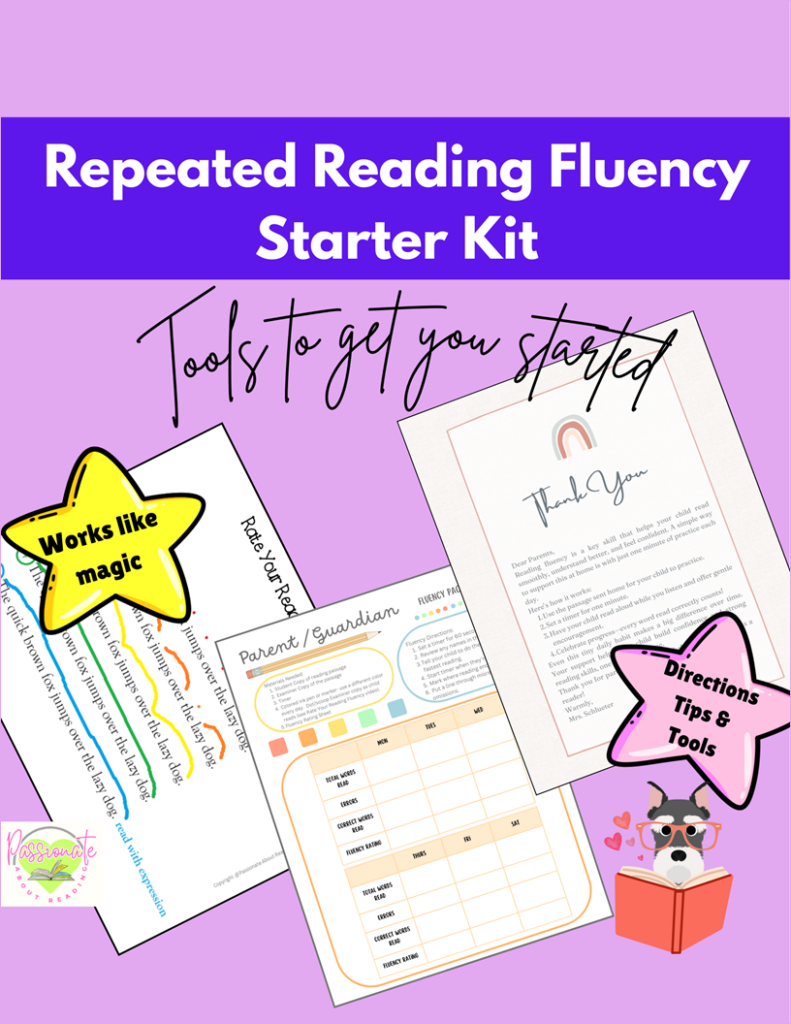
First, I show them my fluency rating sheet and demonstrate how each rating sounds from a rating of 1 to a rating of 5 (the highest). Then, I record their reading and we discuss what rating they think they landed on. You see, I don’t want my students to simply focus on how many words they read per minute. I want them to pay attention to how different the reading sounds and feels each time their fluency improves. Every week, I use short fluency passages. We do this 3-4 days a week using decodable text. But it doesn’t stop there. I send home a grade level passage of authentic text that they read with an adult 6 days a week. One minute a day. That’s it.
One minute of intentional practice can be much more manageable for a student and family than, “Go read for 20 minutes.” The goal isn’t to create an exhausted child who hates reading by bedtime. The goal is to give the student a chance to practice reading accurately and increasingly automatically.
But Does Repeated Reading REALLY Work?
This isn’t just something I made up because I like hearing my students read the same passage four times.😂 There is a substantial base of research behind repeated and guided oral reading.
The National Reading Panel reviewed hundreds of studies related to guided oral reading and found a consistent positive effect on reading outcomes. And Therrien’s 2004 meta-analysis specifically examined repeated reading and found that it can improve reading fluency and comprehension for students with and without disabilities—not only on the practiced passage but also as an intervention aimed at broader reading performance. The research isn’t saying: “Make kids read the same thing 47 times and hope for the best.” The instructional details matter. Students need appropriate text, guidance, feedback, and purposeful practice- about 4 to 6 times a week.
And fluency isn’t simply speed. Researchers and reading experts have long emphasized that fluency also includes appropriate phrasing and expression. Rasinski, for example, has argued that fluency instruction should remain connected to authentic, meaningful reading rather than becoming nothing more than a race to increase words per minute. That’s important to me. I don’t want fast readers. I want efficient readers who understand what they’re reading.
And Then There’s Gabe
Gabe (not his real name) is one of my slowest readers. When I started working with him in fifth grade, he was reading about 25 words per minute. Twenty-five. I don’t know exactly what happened during grades 1–4, but let’s just say that when Gabe arrived in my room, his reading was a hot mess. He wasn’t just slow. He had a long history with huge gaps and you could see what that struggle had done to his confidence. Fast-forward to today. Gabe is a sixth grader and is still one of my slowest readers. But he’s reading 70 words per minute on a cold read using authentic sixth-grade text. Seventy. That’s not where I ultimately want him to be, but here’s what get me. He’s actually setting goals now- on his own! And they’re realistic! He just told me last week that his next goal is 80 words per minute. The biggest change hasn’t been the number. It’s Gabe. His confidence is completely different. He actually enjoys reading now. And that matters. Because imagine being a child who has spent years believing that reading is something you’re bad at. Then one day your student realizes: Wait. I can actually do this. Maybe I’m not the fastest. Maybe I still have work to do. But I can read. And I can get better.
That’s the part of fluency instruction that doesn’t show up on a graph.
The Golden Combination
For me, the magic isn’t phonics OR fluency. It’s both. We spend most of our time building the skills. Explicit instruction. Systematic phonics. Decoding. Word analysis. Error analysis. Practice. Correction. But when a student makes an error, we don’t automatically swoop in and rescue them. We give them an opportunity to use what they’ve learned.
AND we build automaticity. Repeated reading. Feedback. Short, purposeful practice. Fluency ratings. Authentic text. And lots of encouragement along the way. Because they need to feel successful.
Amy’s Take
I think we sometimes accidentally create a false choice: Accuracy OR fluency. I don’t buy it. If a student isn’t accurately decoding, I’m going to slow things down and teach the heck out of the decoding skills. But as those skills are developing, I’m going to make sure their reading begins to sound fluent.
Because the ultimate goal isn’t: “Can you decode this word?” The goal is: “Can you understand this text?” If their reading doesn’t start to sound conversational, the meaning will be missed. I’ve watched students go from guessing to decoding. I’ve watched them go from decoding to accuracy. But I also see them go from accurate, stilted readers to accurate, beautifully expressive ones.
Yes, I want reading to become easier. But I also want them to have enough mental energy left to think about what they’re reading. I want them to sound like readers. And, perhaps most importantly, I want them to feel like readers. Gabe’s 70 words per minute is a data point. But that’s not the victory- his new identity is.
🤓 Research Nerd Corner
If you want to dig deeper into this one, here are a few places I’d start.
National Reading Panel — Teaching Children to Read
The National Reading Panel’s work is foundational here. Its review found strong support for systematic phonics instruction and concluded that guided repeated oral reading positively affects word recognition, fluency, and comprehension.
Therrien (2004) — Repeated Reading Meta-Analysis
This is one of my go-to pieces when someone asks, “But does repeated reading actually work?” Therrien reviewed the research and found that repeated reading can improve both fluency and comprehension, including for students with learning disabilities.
What Works Clearinghouse: Grades 4–9
I especially love this one because it puts decoding and fluency side by side.
Recommendation 1: Build decoding skills.
Recommendation 2: Provide purposeful fluency-building activities.
That combination makes a whole lot of sense to me. And then there’s the classic work of
whose automaticity theory helped explain why developing automatic word recognition matters. When word recognition becomes less attention-demanding, cognitive resources can be freed for higher-level processing.
In other words: We teach kids to decode so they can eventually spend less brainpower decoding.
That’s the whole point.
📚 Amy’s Bookshelf
If you want to dig deeper into fluency instruction, put Timothy Rasinski’s The Fluent Reader on your professional bookshelf.
Rasinski connects word recognition, fluency, comprehension, repeated reading, performance reading, and authentic oral reading practices. The updated edition also includes current research and practical classroom strategies.
I especially appreciate Rasinski’s reminder that fluency is not simply reading fast. Because goodness knows, if our only goal were speed, we’d just hand kids a stopwatch and call it a day. But that’s not what good reading instruction looks like.
One Last Thought
Maybe the question isn’t: “Can this student decode?” Maybe we need to ask: “What happens after they decode?” Because that little space between accurate and automatic can make a huge difference in a struggling reader’s experience.
And sometimes the student who looks like they just need to “try harder” actually needs something much more specific: practice, guidance, encouragement, purpose.
That’s why I created my Repeated Reading Fluency Starter Kit—because I wanted teachers to have an easy, low-prep way to put this research into practice without spending time reinventing the wheel. Grab yours now and see what a difference one minute a day can make. 😍