Why struggling readers sometimes need to read the same thing again—and why more isn’t always better.
Last Updated 9/5/26
By Amy Schlueter
“Mama, again! Again!”
Those were the sweet—or not-so-sweet-after-a-long-day-and-it’s-way-past-bedtime—sounds of my girls when they were toddlers. It didn’t matter how many times Emily heard the same nursery rhyme. She wanted me to sing it again. And Audrey was all about Goodnight, Moon. Over. And over. And over. And you know there was NO skipping a page.
Obviously, toddlers have very strong opinions about fidelity to the original text. But back then, I wasn’t thinking, Ah yes, what a perfect demonstration of repeated exposure supporting language development and automaticity. Nope. I was thinking, Please. Just. Go. To. Sleep.
But something important was happening. They were learning- the words, the rhythm, the language patterns, and the vocabulary. They were learning the sequence of the story. They were beginning to anticipate what came next. And because parts of the story were becoming familiar, they had more mental energy available to notice other things. Repetition was doing some serious heavy cognitive lifting.
Fast-forward a couple of decades, and now I’m the one saying: “Read it again.” And I have great reasons.
Decoding Is Not Comprehending
I was abundantly reminded of that fact this week while reading The Mummy King with four of my students. It was a magazine article in Storyworks– one of my absolute favorite magazines for reading intervention because, honestly, if I’m going to ask kids to read something multiple times, it better be interesting. Plus Lauren Tarshis, the author of all the “I Survived” books- is Senior VP and editor at large- so how can you go wrong?
Anyway, this article was definitely interesting. At one point, Ryder* read that more than 6,000 objects were buried with King Tut. All four students followed along. But nobody blinked. Nobody gasped. Nobody said, “WHAT?!” Nothing.
Just four kids sitting at the table acting like he had read that it was just another sunny day in Egypt. So I stopped him. “Wait. What???” They looked at me funny. “Read that again, Ryder.” He did. And then…Two of the four mouths dropped open. The other two? Still nothing. Just… Yep. Six thousand objects. Moving on. So I said, “Read it again.” And THAT time, the other two looked up. “How many?!,” I asked. “Oh my gosh! 6,000!” “That’s crazy!” “How big can that tomb possibly be?” “Why did they put so much stuff in there??”
There it was. That was the moment I wanted. Because the first time they read the sentence, they decoded it. But decoding the words didn’t automatically mean they had processed the significance of what those words meant. They had to get through the words. They had to process the vocabulary. They had to make sense of the sentence. They had to connect that information to what they knew. And THEN… their brains had enough space to think: Wait a minute. SIX THOUSAND?! That’s comprehension. And sometimes comprehension doesn’t happen on the first pass. Sometimes the first read is just getting through it. The second read gives the brain another opportunity to process the meaning. And sometimes…we need a third read because apparently 6,000 Egyptian artifacts isn’t immediately mind-blowing to everyone. I’m looking at you, kids. 😉
* not his real name
Repetition Isn’t a Punishment
But here’s where I think we sometimes get ourselves into trouble. A student reads something once. Maybe they even read it with prosody. We assume they got as much out of it as we did. So we move on. New passage. New vocabulary. New words. New cognitive load. And then we wonder why the student isn’t becoming more fluent. Or why comprehension seems shaky. Or why a student can tell us what happens if someone else reads the passage aloud but they can’t explain it when they read it independently.
And the answer could be that they need another encounter with the text. There is quite a bit of research behind that idea. Therrien’s 2004 meta-analysis found that repeated reading improves both reading fluency and comprehension, including students with learning disabilities. The research also suggests that repeated reading can be useful not only for improving performance on the practiced passage but as an intervention to support broader fluency and comprehension. So no, we’re not making kids read something again because we’ve run out of things to do.
We’re giving the brain another opportunity to process it. But—and hear me on this—
More Isn’t Always Better
Once we hear that repeated reading works, it’s very tempting to turn it into a recipe. Read it three times! Or five! Or seven! Or until someone starts chewing on the pencil! No. That’s not the point.
Research tells us repetition can help, but the benefits aren’t necessarily equal with every additional reading. O’Shea and colleagues studied students reading passages one, three, and seven times. Both fluency and comprehension improved with repeated readings, but the study added a twist. Students who were cued to focus on meaning comprehended more than students who were cued primarily to focus on fluency. And in their study with students identified as learning disabled, students recalled more of the story after three readings than after one, while fluency continued to improve with additional readings. That’s a pretty important distinction.
So while seven reads may continue to improve fluency, it doesn’t mean seven reads are necessary for comprehension. And this is where good intervention requires us to pay attention to the actual child sitting in front of us. Because if I’m making a struggling reader read the same passage eight times after the student has already demonstrated accuracy, appropriate phrasing, and comprehension… I’m not necessarily providing better instruction. I may just be providing eight opportunities to become really annoyed with me. And honestly? Who wants to annoy their students?
We Need to Find the Sweet Spot
This is where I think our job as interventionists gets really interesting. We have to find the sweet spot. Enough repetition to build automaticity. Enough repetition to reduce the cognitive load of word recognition. Enough repetition to make vocabulary and language more familiar. Enough repetition for the reader to move from: “What does this say?” to: “What does this mean?”
But not so much that our student is bored, frustrated, disengaged, or simply memorizing the passage. Purposeful repetition. That’s the key. As an interventionist, it’s just as important for me to have an idea of what I want my students to accomplish as it is for them to read repeatedly. Maki and Hammerschmidt-Snidarich’s 2022 meta-analysis examined the dosage of reading-fluency interventions across 33 studies. Overall, fluency interventions produced a moderate effect, but the researchers also pointed out that we still don’t have a simple answer for exactly how much intervention—or how much practice—is optimal. In other words: More isn’t automatically better. Better is better.
First Read: “What Do These Words Say?”
For a struggling reader, the first encounter with a passage can be hard work. What does that word say? Wait…what’s that ending? Go back. Sound it out. What’s that word? Okay, now what was this sentence about?
And while the student is doing all of that, the meaning of the passage can get pushed to the side. That’s why automaticity matters. When word recognition becomes more efficient, the reader has more cognitive capacity available for meaning. The goal isn’t to make kids read faster simply because faster sounds good on a progress-monitoring graph. The goal is to make reading less effortful so the student has enough mental energy left to think.
Second Read: “Ohhh…NOW I Get It.”
On the second encounter, some of that cognitive work has already been done. The words aren’t quite as unfamiliar. The sentence isn’t completely new. The student has some idea of what’s coming. And now there may be room for something else. Meaning. That’s what happened with my four King Tut readers. They had already decoded the words “6,000 objects.” But repetition gave their brains another opportunity to move beyond: “I can read those words.” to: “I understand what those words mean.”
And that distinction is HUGE.
Sometimes We Have to Say, “Look Again.”
This is where O’Shea’s research is particularly interesting. Repeated reading isn’t the whole story. The purpose we give the reader matters. If we’re constantly saying: “Read it faster.” “Let’s see if you can beat your score.” “Can you get more words per minute?”…we may get faster reading. But faster isn’t necessarily deeper.
O’Shea and colleagues found that students cued to attend to comprehension showed stronger comprehension than students whose attention was directed toward fluency. So sometimes our prompt should be: “Read that again. What is the author actually telling you?” Or: “Wait. How many objects?” Or simply: “Go back. Read that sentence again.”
We’re not just asking the student to repeat. We’re giving the brain a reason to repeat.
And This Is Why I Love Authentic Text
This is also why I love using interesting text with my intervention students. Because once a student has decoded the words, I want them to care about what those words mean. I want them to discover something. I want them to be surprised. I want them to argue about it. I want them to say: “Wait…whaaaaat?!” I want them to learn something they didn’t know five minutes ago. That’s much harder to do when the only purpose of reading is: “Let’s get your words per minute up.” Fluency matters. Accuracy matters. Automaticity matters. But they’re not the destination. They’re the road that gets us to meaning.
Sometimes “Again” Is Exactly What a Reader Needs
One of my favorite things to watch during intervention is the moment when a student realizes something has changed. The first read might be slow. Lots of stopping. Lots of decoding. Maybe a few substitutions. The student is working. Hard. Then we read it again. And something shifts. The second read is smoother. The student recognizes more words. The sentence makes more sense. The student isn’t working quite so hard. And suddenly… they have room to think.
That’s what happened with my King Tut group. First: 6,000 objects. Okay. Second: 6,000 objects. Hmm. Third: SIX THOUSAND?! OH MY GOSH! THAT’S CRAZY! YES. That is the moment. Not because I needed them to read the sentence three times. Because I needed them to understand it.
So What Should We Do?
Don’t automatically move on just because a student has read something fluently. But don’t automatically make them read it seven times either. Instead, ask yourself: What does this student need from another reading? Do they need more accuracy? More automaticity? Smoother phrasing? More vocabulary processing? A chance to notice the syntax? A cue to focus on meaning? A chance to connect the information to what they already know? Then repeat with a purpose.
And watch the student. Listen. Notice when the work gets easier. Notice when comprehension clicks. And when the student has gotten what they need from that text? Move on. Because our goal isn’t to see how many times we can make a child read the same passage.
Our goal is to help that child become a more capable reader.
☕ Amy’s Take
For my struggling readers, repeated reading is most effective when the first read isn’t expected to do everything. The first read may be about getting through the words accurately. The student is decoding, working through unfamiliar vocabulary, and trying to hold the sentence together. On the next read, some of that work has become easier. Now the student has more cognitive space to notice meaning, syntax, vocabulary, and connections. And sometimes that’s when the lightbulb comes on.
Just like my King Tut readers: 6,000 objects. Yep. 6,000 objects. Okay. SIX THOUSAND?! OH MY GOSH! THAT’S CRAZY! 😂
That’s the sweet spot I’m looking for. I’m not interested in making a student read the same passage eight times simply because someone decided that eight is the magic number. I want to repeat the text while the repetition is still doing instructional work. When accuracy improves, fluency becomes more automatic, and comprehension deepens, I’m getting exactly what I want from that repetition.
Then we move on. Because the goal isn’t to create a kid who can read one passage really, really well. The goal is to create a reader who can take what they’ve practiced and use it when the words are new.
That’s the whole point.
🤓Research Nerd Corner
Want to go down the rabbit hole with me? Here are the three studies that informed this post:
Therrien, W. J. (2004). Fluency and Comprehension Gains as a Result of Repeated Reading: A Meta-Analysis. Remedial and Special Education, 25(4), 252–261.
Repeated reading was found to support both fluency and comprehension and was effective with students with and without disabilities.
Read the Therrien article / abstract
O’Shea, L. J., Sindelar, P. T., & O’Shea, D. J. (1985). The Effects of Repeated Readings and Attentional Cues on Reading Fluency and Comprehension. Journal of Reading Behavior, 17(2), 129–142.
This study is especially interesting because it showed that what we cue students to pay attention to matters. Students directed toward meaning comprehended more than students directed toward fluency alone.
Read the O’Shea article
Maki, K. E., & Hammerschmidt-Snidarich, S. (2022). Reading Fluency Intervention Dosage: A Novel Meta-Analysis and Research Synthesis. Journal of School Psychology, 92, 148–165.
This meta-analysis examined 33 studies and found an overall moderate effect for reading-fluency interventions while highlighting how much we still need to learn about intervention dosage.
Read the Maki article on PubMed
📚 Amy’s Bookshelf
And if you’re wondering which one I’d put on the professional bookshelf? Maki & Hammerschmidt-Snidarich (2022), “Reading Fluency Intervention Dosage: A Novel Meta-Analysis and Research Synthesis.”
Because it pushes us past the simple question of “Does repeated reading work?” and into the much more useful question: “How much is enough for THIS student?” And that’s where evidence-based practice gets interesting. The part that really grabbed me wasn’t simply that fluency intervention works. It was the reminder that more isn’t automatically better. This matters because it’s incredibly easy to take something supported by research and turn it into a recipe.
Repeated reading works! Great. So… Read it again. And again. And again. And again. Until everyone at the table is questioning why they didn’t have Mom call them in sick. 😂
But that’s not what good intervention looks like. The research on dosage reminds us that how much practice a student receives matters—and that we still have to pay attention to the student in front of us. There isn’t a magic number of repetitions that works for every reader, every passage, or every instructional goal.
That’s where our professional judgment comes in. With my intervention students, I’m watching for the point where repetition is still doing useful work. Is the reading becoming more accurate? Is word recognition becoming more automatic? Is the student using less brain power to get through the words? Is vocabulary becoming more familiar? Is the student finally making the connections that lead to comprehension?
That’s the sweet spot.
And once the repetition stops adding something meaningful, I move on. Because there’s a difference between practice and overpractice. Too little repetition, and the student may not get enough successful encounters with the text to build automaticity and comprehension. Too much repetition, and we risk boredom, frustration, disengagement, and a student who learns to associate reading intervention with the words: “Ugh. Not this story AGAIN.” Our job is to find the middle.
That’s one of the things I love most about being a reading specialist. The research gives us the why. The data gives us information. Our training gives us tools. But the child tells us what to do next. So don’t just count repetitions. Watch the reader. Listen for changes in fluency. Notice when the student stops working so hard. Pay attention to when comprehension suddenly appears. And know when the instructional benefit has been reached.
Because good intervention isn’t about doing more. It’s about doing what this student needs, at this moment, for this particular skill. Stay curious. Study the research. Collect the data. But most importantly, pay attention to the kids sitting at your table.
That’s where you’ll find the sweet spot.
Maybe Toddlers Have It Right
So maybe those little voices saying, “Mama, again!” were onto something. Repetition matters.
It gives the brain another opportunity to build connections, strengthen automaticity, process language, and construct meaning. But there’s an important caveat: Repetition is a tool, not a punishment. We don’t need to repeat something simply because we can. We need to repeat it because the student is still getting something from it.
Find the sweet spot. Enough repetition to make reading easier. And to make meaning clearer. Enough to let the brain catch up. But not so much that the student is staring at you thinking, If she makes me read this one more time, I may fake a fire drill.
Because the goal isn’t more reading. The goal is better reading. And ultimately, we want readers to have enough automaticity and cognitive space to do the thing we really care about: Think. Wonder. Learn. Connect. And occasionally…realize that 6,000 things buried with one guy is absolutely bananas.
Ready to Put Repeated Reading to Work?
You know that repeated reading works. Now you just need the tools to make it easy and purposeful.
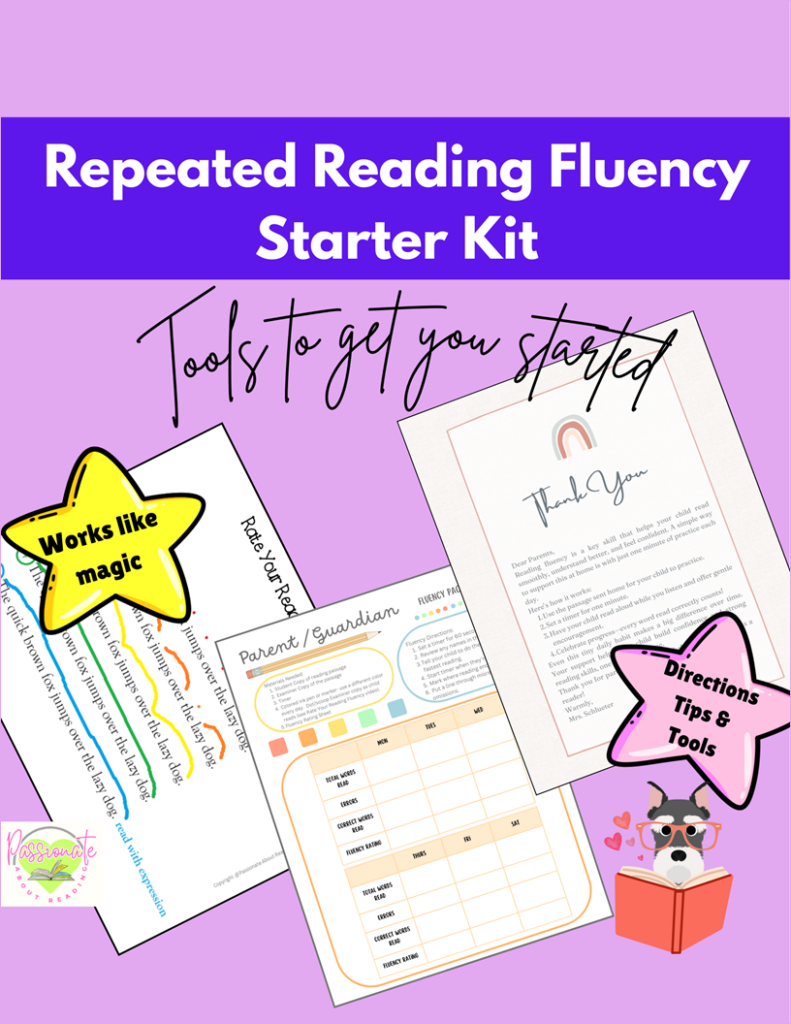
My Repeated Reading Fluency Starter Kit gives you ready-to-use resources to help your students build accuracy, automaticity, phrasing, and fluency—without spending your precious planning time creating everything yourself. Because you have enough on your plate.
Let me handle the prep. You focus on the reader. ❤️ Your students get meaningful practice. You get one less thing to create. Everybody wins. 😉